
The Amsterdam Guide
From protest to Canal Parade: the story of Pride in Amsterdam
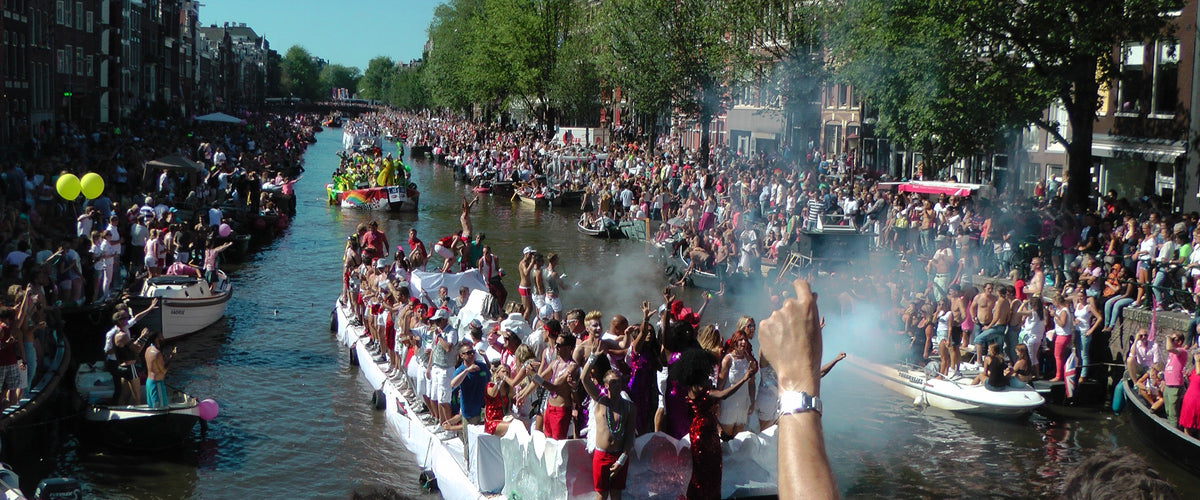
Once a year, Amsterdam’s canals become a moving stage. Decorated boats pass between canal houses while balconies, bridges and quays fill with people. Rainbow flags hang from windows, music carries across the water and the city seems to celebrate in every direction at once.
The Canal Parade looks inevitable now, as if Amsterdam’s canals had always been waiting for Pride to arrive. In reality, the first boat parade took place only in 1996. It was created as a celebration rather than a protest march and was initially intended to last just three years.
Yet the freedom it celebrates was not simply given to the city. It was built through decades of organising, demonstrations, cultural spaces, legal battles and people refusing to remain invisible. The story of Pride in Amsterdam therefore begins long before the first boat entered the Prinsengracht.
It begins with the right to be seen.
A tolerant city—with conditions
Amsterdam has a long reputation as a place where people could live differently, but tolerance is not the same as equality. For much of the twentieth century, gay men and lesbian women risked rejection by their families, discrimination at work and police attention. Meeting places existed, but many operated discreetly.
In 1946, activists in Amsterdam founded what would become the COC, now the world’s oldest surviving LGBTQIA+ organisation. At first it used the deliberately harmless-sounding name Cultuur- en Ontspanningscentrum—Culture and Recreation Centre. The name allowed the organisation to work in a society where homosexuality remained heavily stigmatised.
The legal situation reflected that inequality. Article 248bis of the Dutch Criminal Code, introduced in 1911, set a higher age of consent for same-sex contact than for heterosexual contact. It was finally abolished in 1971 after years of campaigning.
Social space expanded gradually. Amsterdam developed cafés, clubs, associations and publications where gay and lesbian people could meet. Places such as Café ’t Mandje on the Zeedijk had already offered refuge to outsiders, while post-war venues connected to the COC helped create a more organised community.
By the 1960s and 1970s, hiding was increasingly being replaced by visibility. Amsterdam’s queer nightlife flourished, but activists wanted more than permission to dance behind closed doors. They wanted equal treatment in public life.
1977: stop the witch-hunt
The first large national Pride-style march in the Netherlands took place in Amsterdam on 25 June 1977. Its immediate cause lay thousands of kilometres away.
In Miami-Dade County, singer and campaigner Anita Bryant led a movement to overturn protection against discrimination based on sexual orientation. Her “Save Our Children” campaign portrayed homosexual people as a danger to children and inspired similar campaigns elsewhere.
The backlash reached the Netherlands. Lesbian feminist groups, including the International Lesbian Alliance and women associated with Lesbian Nation, took a leading role in organising an International Gay Liberation and Solidarity Day in Amsterdam. Around two thousand people marched through the city beneath banners protesting the American “witch-hunt” against homosexuals.
This history matters because the Dutch Pride movement was not created only by male nightlife entrepreneurs or established organisations. Lesbian and feminist activists were central to one of its defining early moments.
The 1977 march became a precursor to the annual Dutch emancipation demonstration later known as Roze Zaterdag—Pink Saturday. From 1981 onward, that event travelled between different Dutch cities rather than belonging permanently to Amsterdam.
The protest also established a pattern that still shapes Pride: injustice elsewhere is not someone else’s problem. Amsterdam’s visibility could be used to support people facing discrimination far beyond the Netherlands.

Remembering those who could not be visible
Visibility is joyful when it is chosen. History also contains countless people who were punished for it.
During the Nazi occupation, homosexual men were persecuted under German law, while Dutch gay and lesbian people faced arrest, denunciation, forced secrecy and the destruction of their social networks. The full history is complex: not everyone was registered or persecuted in the same way, and many lives disappeared from the archive precisely because secrecy had been necessary.
After the war, homosexual victims received little public recognition. In 1970, activists attempting to lay a wreath at Amsterdam’s National Monument on Dam Square in memory of persecuted gay people were stopped and arrested. The incident strengthened calls for a permanent memorial.
It took years of campaigning, fundraising and debate before the Homomonument was finally unveiled beside the Westerkerk on 5 September 1987. Designed by Karin Daan, it consists of three large pink granite triangles connected across the Westermarkt.
The form reclaims the pink triangle once used by the Nazis to identify homosexual prisoners. One triangle reaches into the Keizersgracht and serves as a place for flowers and remembrance. Another rises as a platform. The third carries a line by the gay Jewish Dutch poet Jacob Israël de Haan: Naar vriendschap zulk een mateloos verlangen—“Such an immeasurable longing for friendship.”
The Homomonument was the first free-standing monument of its kind in the world. It looks backwards to persecution, stands in the present as a meeting place and points towards a future in which no one is oppressed because of sexuality or gender identity.
That combination—remember, protest and celebrate—would later become the emotional structure of Amsterdam Pride itself.

The difficult 1980s
The opening of the Homomonument took place during another painful period in queer history. The HIV/AIDS crisis devastated communities in Amsterdam and around the world. People lost partners, friends and chosen family while fear and misinformation revived old prejudices.
Queer organisations, volunteers, doctors and activists built support networks, demanded honest public information and cared for people whom others avoided. The crisis made visibility more urgent, but also more dangerous. Coming out could mean finding community; it could also expose someone to blame, discrimination or abandonment.
Amsterdam nightlife offered moments of escape and solidarity. Clubs and bars became places where grief, desire, art and activism existed beside one another. By the late 1980s and early 1990s, venues such as RoXY and iT helped give Amsterdam an international reputation for extravagant and experimental nightlife.
That creative energy would feed directly into the first Amsterdam Pride.
1996: the parade takes to the water
Amsterdam Pride began differently from many Pride events around the world. It was not founded as an annual protest march commemorating Stonewall. In 1996, gay hospitality entrepreneurs united in Gay Business Amsterdam organised it as a celebration of freedom, diversity and the city’s gay nightlife.
The Canal Parade was their most Amsterdam-like idea. Instead of marching through streets, participants would sail through the seventeenth-century canal belt. The city itself became the backdrop, while the water created a stage visible from bridges, windows, houseboats and quays.
The first parade took place on 3 August 1996 with more than 45 boats and small craft. Participants were required by the police to sign a declaration of decency—an unintentionally perfect reminder that official tolerance still came with conditions.
The plan was to organise the parade only three times: in 1996, as a rehearsal in 1997 and finally alongside the Amsterdam Gay Games in 1998. It proved far too popular to stop.
The first Canal Parade did not replace the history of protest. It added another strategy: claiming public space through visible joy. Dancing on a boat might look less political than carrying a banner, but for people who had been expected to remain discreet, celebration itself could be a public statement.

The Gay Games change the scale
In 1998, Amsterdam became the first European city to host the Gay Games. More than fourteen thousand participants competed in sports and joined a vast cultural programme. The event gave many LGBTQIA+ visitors the rare experience of feeling not like a small tolerated minority, but like the centre of the city.
The Gay Games helped transform Pride from a weekend built around nightlife into a broader programme of sport, culture, community and public visibility. After 1998, the Canal Parade continued as an annual event, with the number of participating boats eventually limited to eighty.
The parade also became a platform. Community organisations used boats to make overlooked groups visible. Religious communities, young people, older LGBTQIA+ people, people with disabilities, military personnel, police networks and communities with bicultural backgrounds all claimed a place on the water.
These appearances were not always uncomplicated. Being represented by an institution does not guarantee equal treatment within it. But the sight of organisations publicly supporting LGBTQIA+ employees and members helped change what Dutch society considered normal.
From visibility to legal equality
Amsterdam’s growing Pride coincided with major legal change. On 1 April 2001, Mayor Job Cohen officiated the world’s first marriages between same-sex couples at Amsterdam City Hall after the Netherlands became the first country to open civil marriage equally.
The moment confirmed Amsterdam’s international image as a capital of LGBTQIA+ freedom. It was a genuine milestone, but legal equality did not end discrimination. Violence, bullying, family rejection and unequal safety continued. Transgender and intersex people often found that achievements described as “gay rights” did not automatically address their needs.
Pride therefore broadened. The word gay gradually gave way to more inclusive language, while programmes gave greater space to lesbian, bisexual, transgender, intersex, queer and non-binary experiences. The Pride Walk, introduced in 2012, restored an explicitly activist march to the festival alongside the Canal Parade.
Amsterdam Pride became both the party founded in 1996 and the protest tradition that came before it.
Who gets a place on the boat?
Success brought new tensions. As the Canal Parade attracted enormous audiences, participation became valuable. Banks, technology companies, government departments and major brands appeared beside activist and community organisations.
Corporate support helps fund an event with substantial safety, organisation and cleaning costs. A company boat can also show employees that they do not need to hide at work. Yet critics question whether rainbow branding is meaningful when a company’s policies, investments or behaviour fail to support LGBTQIA+ people during the rest of the year.
The parade has faced broader questions about representation too. Does its most visible imagery reflect the full community? Are people of colour, transgender people, women, people with disabilities and queer people without access to large organisations heard as clearly as well-funded participants? Can a festival remain politically sharp when it is also a major tourist attraction?
There is no final answer. Pride has never been one single community agreeing with itself. Its arguments are evidence that visibility alone is not enough; people also want influence over what that visibility means.

A celebration that still needs protest
In 2026, Amsterdam marked thirty years of the Canal Parade while hosting WorldPride for the first time in the Netherlands. The year also celebrated twenty-five years since the opening of marriage to same-sex couples.
Those anniversaries showed how much had changed since activists marched through Amsterdam in 1977. They also arrived at a moment when LGBTQIA+ rights and safety were again under pressure in many countries. Even in the Netherlands, legal protection does not ensure that everyone feels safe at home, at school, at work or in the street.
That is why the distinction between party and protest has become less useful. A parade boat can carry music and a political demand. A memorial can host both mourning and celebration. A rainbow flag can be cheerful decoration, a commercial logo or a lifeline telling someone they are not alone.
Amsterdam Pride contains all of these at once.
The city as a stage
The canals give Amsterdam’s Pride its famous image, but they also give it meaning. Ordinary parades move through a city. The Canal Parade temporarily transforms the city itself: bridges become grandstands, canal houses become flagpoles and water that once carried merchants now carries communities demanding to be recognised.
Its route passes the architecture of Amsterdam’s celebrated past while showing people who were often excluded from official versions of that history. That contrast is what makes the parade more than a colourful summer event.
The boats of 1996 were intended as a temporary gift. Instead, they created a tradition because the city needed both the freedom of the party and the message beneath it.
Pride in Amsterdam began with people refusing a witch-hunt, built a monument to those who could not live openly and eventually filled the canals with public joy. The music, costumes and crowds may be the easiest things to photograph. The real story is the long struggle that made such photographs possible.