
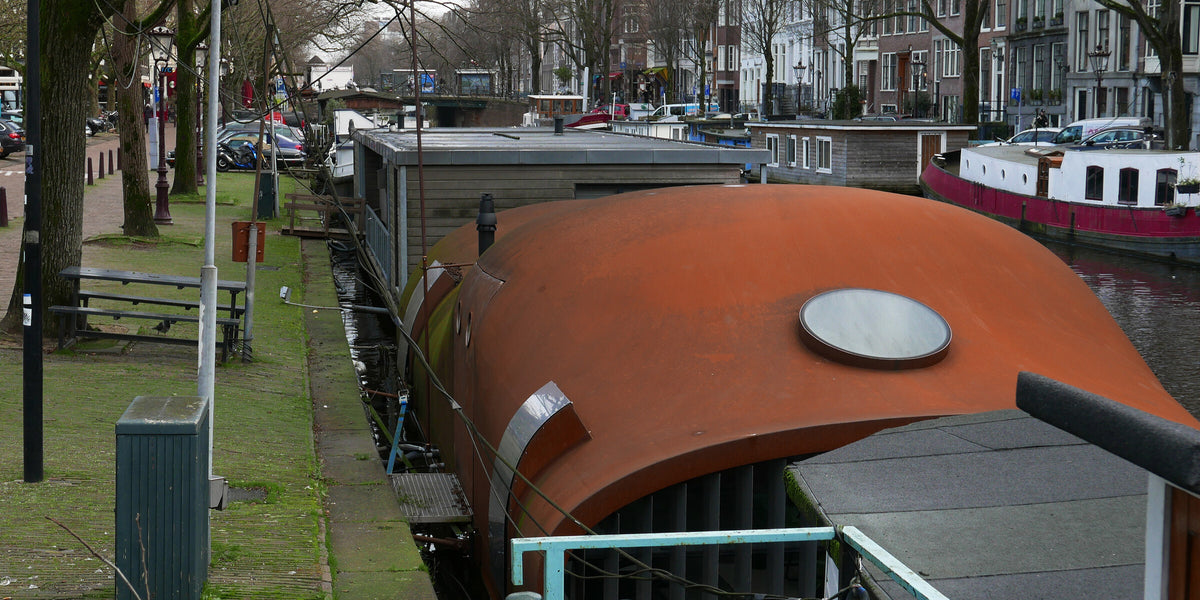
Amsterdam’s canals were built for transport, trade and water management — not as residential streets. Yet today, houseboats feel as much a part of the city as canal houses, bicycles and arched bridges. Behind their flower boxes and wide waterside windows lies a story shaped by working ships, housing shortages and an unconventional idea of home.
Living on the water was not always the romantic Amsterdam dream it appears to be today. For many early residents, it was simply an affordable way to find shelter in an overcrowded city.
People lived on the water long before the modern houseboat
People were already living aboard vessels in Amsterdam in the seventeenth century. Some were travelling traders who sold goods directly from their boats, often to the irritation of city authorities and established shopkeepers. These early floating homes were closely connected to work: the boat was transport, workplace, storeroom and living space all at once.
By the nineteenth century, simple floating dwellings could be found around Amsterdam’s harbours and industrial edges. Their residents were often labourers and shipyard workers. Conditions were basic, and the structures were sometimes dismissively called hondehokken — dog kennels. Life on the water belonged to the practical, working side of the city rather than its elegant image.
When working boats became homes
At the end of the nineteenth century and during the early twentieth century, inland shipping changed. Wooden sailing barges were gradually replaced by newer steel vessels. Retired cargo boats could be bought relatively cheaply, and their large holds offered something Amsterdam desperately needed: space.
Owners added windows, insulation, stoves and simple living quarters. A vessel that had once carried sand, timber or vegetables could begin a second life as a home. These converted ships became known as woonschepen — residential vessels that still visibly retain the shape and character of a boat.

A floating answer to the housing shortage
Houseboat living expanded dramatically after the First World War and again after the Second World War. Amsterdam faced a severe housing shortage, while the inland shipping fleet was being modernised. Old vessels were available, conventional homes were not, and the canals offered places where people could improvise.
For some families, a converted ship was one of the few affordable options. Living conditions could be primitive: limited heating, damp interiors, little insulation and unreliable access to utilities were common. Some boats housed more than one family. The postcard image of breakfast beside a sparkling canal came much later.
The city attempted to regulate floating homes through permits and rules, but houseboat communities continued to grow. By the 1960s and 1970s, living on the water also began to attract students, artists, free spirits and people drawn to a less conventional life. The houseboat became both a practical home and a small act of independence.

From ship to ark
Not every houseboat is actually a boat. Amsterdam has two main types of floating home.
A woonschip is a former working vessel converted for residential use. Its hull, deckhouse and wheelhouse often reveal its earlier life. Inside, the old cargo hold may have become a surprisingly spacious living room, although curved walls and low ceilings can make every centimetre count.
A woonark, or residential ark, is built specifically as a home on a floating base, traditionally made from steel and more commonly from concrete today. It may look like a compact bungalow sitting on the water rather than a ship. Arks offered straighter walls, larger windows and layouts closer to those of an ordinary house.
Together, converted ships and purpose-built arks created the wonderfully irregular waterside architecture seen throughout Amsterdam today.
A permanent address, but never ordinary
Modern Amsterdam houseboats are usually connected to electricity, drinking water and sewerage. Many have underfloor heating, fitted kitchens, roof terraces and carefully designed interiors. Yet life afloat still has its own rhythm.
The water moves. Boats pass close to the windows. Ducks arrive with the confidence of neighbours who have never paid rent. Maintenance is different from maintaining a house on land, and the hull or floating structure must remain safe. Even a beautifully renovated houseboat never lets its residents completely forget where they are.
Space also demands creativity. Built-in storage, made-to-measure furniture and carefully positioned curtains can turn awkward corners and wide waterside windows into a comfortable home. On a houseboat, interior design is not decoration added at the end; it is often what makes the limited space work.
From affordable refuge to coveted home
The greatest change is not visible in the boats themselves, but in their value. Amsterdam no longer freely adds new residential moorings, and a legal place on the water is scarce. What began as an inexpensive alternative during times of housing shortage has therefore become highly desirable.
A houseboat can offer something exceptionally rare in a dense city: an open view, direct contact with the water and a sense of privacy in the middle of Amsterdam. The humble floating homes once associated with workers and people living on the margins are now among the city’s most recognisable residences.
That transformation mirrors Amsterdam itself. The canals have always adapted — from commercial infrastructure to historic landscape, and from working waterfront to living neighbourhood. Houseboats are not simply picturesque objects moored in front of the canal houses. They are homes created from necessity, reinvention and the stubborn Amsterdam habit of using every available metre — even when that metre happens to float.