
The Amsterdam Guide
Behind the red lights: how Amsterdam’s most notorious district rose—and began to change
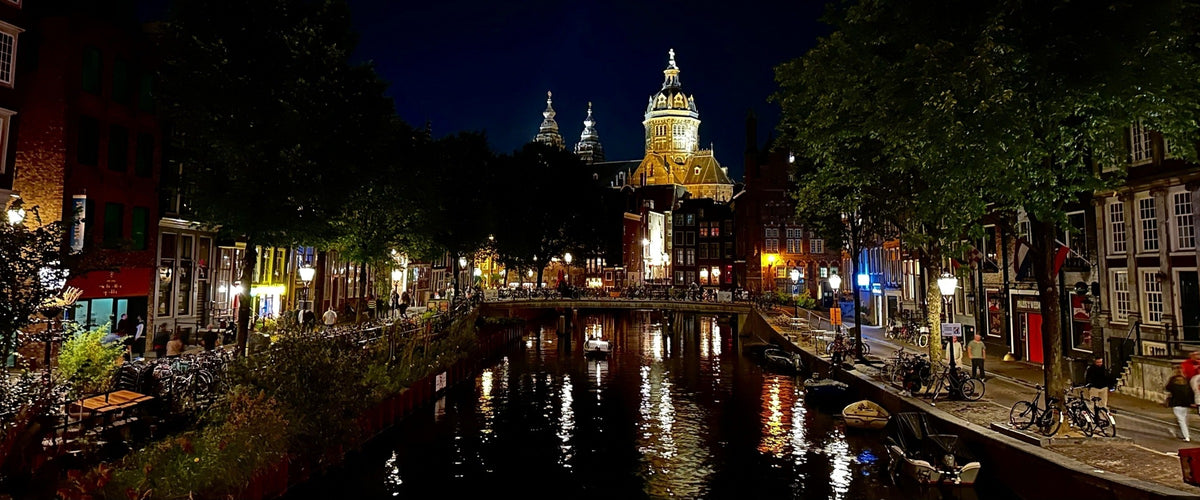
The red lights are only the most visible layer of De Wallen. Behind them lies Amsterdam’s oldest neighbourhood: a dense web of canals, narrow lanes, former warehouses, ordinary homes and the Oude Kerk, the city’s oldest surviving building.
For centuries, sailors arrived here looking for food, drink, a bed and company. Sex work became part of that harbour economy, surviving repeated attempts to regulate, prohibit or hide it. Much later, the windows turned the neighbourhood into an international symbol of Dutch tolerance. Then cheap travel and mass tourism transformed it again—this time into a spectacle watched by millions.
Today, Amsterdam is trying to answer an uncomfortable question. How can De Wallen remain a real neighbourhood, protect the people who work there and escape the kind of tourism that treats both as scenery?
This is not simply the rise and fall of the Red Light District. It is the story of a working neighbourhood repeatedly reinvented by trade, poverty, tolerance, crime, tourism and city policy.
Before the red lights
De Wallen grew in the medieval heart of Amsterdam, around the Oude Kerk and the city’s early harbour. Its name refers to the defensive earthworks and waterways that once marked the edge of the settlement. The Oudezijds Voorburgwal and Oudezijds Achterburgwal still preserve that history in their names: the “front” and “rear” walls on the old side of the Amstel.
The location shaped everything that followed. Ships unloaded nearby, inns filled with transient workers and the streets around the harbour became places of trade and entertainment. Sailors might remain in the city for only a few days before leaving again. Taverns, lodging houses, gambling and paid sex naturally clustered close to the waterfront.
Sex work in medieval and early-modern Amsterdam was neither fully accepted nor successfully eliminated. Authorities alternated between restriction, punishment and practical tolerance. After the Protestant Alteration of 1578, brothels were officially forbidden, but the trade continued in taverns, lodging houses and private rooms. Enforcement was uneven and often concentrated on women, madams and public disorder rather than on making prostitution disappear.
Court and confession records reveal individual women behind that system. Some came to Amsterdam from elsewhere in the Dutch Republic or from abroad. Many worked in insecure circumstances and faced fines, banishment or confinement when arrested. The romantic idea of a permanently tolerant Amsterdam hides a much rougher reality: the city tolerated what it could not suppress, but that did not mean it protected the people doing the work.

A neighbourhood, not a separate world
De Wallen was never occupied by sex businesses alone. Merchants, craftsmen, printers, shopkeepers, families and church workers lived beside inns and brothels. Around the Oude Kerk, respectable commerce and paid sex could exist within metres of one another.
That mixture remained characteristic well into the twentieth century. The Zeedijk had cafés, grocers, workshops and boarding houses as well as places connected to prostitution. The neighbourhood developed its own social codes. Residents, bar owners, sex workers, police officers and local characters knew one another, even when their relationships were far from friendly.
One famous example was Café ’t Mandje, opened on the Zeedijk by Bet van Beeren in 1927. It became a meeting place for sailors, artists, sex workers and Amsterdam’s gay and lesbian community. In a city that was not nearly as socially liberal as its later reputation suggests, the café offered a rare space where outsiders could feel at home.
This was the old Zeedijk at its most recognisable: rough, intimate and socially mixed. It could be welcoming to people rejected elsewhere, but it could also be dangerous. Nostalgia tends to polish away the poverty, exploitation and violence that existed alongside the camaraderie.

How the window changed the street
Window prostitution is often imagined as an ancient Amsterdam tradition. It is not. Paid sex had existed around the harbour for centuries, but the familiar illuminated window developed much later.
After Amsterdam prohibited brothels at the beginning of the twentieth century, prostitution continued in less visible forms. Women received clients in rented rooms or discreet houses, while police attempted to control street solicitation and public nuisance. A woman sitting near a front window could signal that she was available without openly soliciting in the street. Curtains offered both concealment and communication.
Over time, those curtains opened farther. By the middle of the twentieth century, the window had become a recognisable feature of the district. The arrangement gave independent workers a visible place to meet clients, but the rooms and windows were usually rented from operators. That created a business model that could offer autonomy while still leaving workers vulnerable to high rents, exploitative managers and criminal control.
The red light itself was practical advertising, not a carefully designed piece of city branding. Yet it became one of the most powerful urban images in the world.

From local trade to public spectacle
During the 1950s and 1960s, the district became more openly associated with sex. Window prostitution expanded, sex theatres and shops appeared and changing attitudes made sexual imagery more visible. Amsterdam’s international reputation for personal freedom grew at the same time.
But the neighbourhood still functioned as a workplace and a home. Many sex workers, operators and café owners lived nearby. Clients generally arrived individually or in small groups. Visitors knew that unwritten rules applied: do not stare for too long, do not interfere with someone’s work and do not treat the neighbourhood as a zoo.
The later tourist version of De Wallen would weaken those boundaries. Visibility, once part of the window worker’s control over finding clients, also made the women vulnerable to being photographed, filmed and judged by crowds with no intention of paying for their time.
Heroin and the hard years
The 1970s and 1980s changed the old centre dramatically. Heroin entered Amsterdam and the area around the Zeedijk became one of the city’s most visible drug markets. Dealers and addiction dominated parts of the street. Residents and shopkeepers faced theft, discarded needles and violence, while neglected and boarded-up buildings deepened the sense of decline.
The problems surrounding drugs became entangled with prostitution, organised crime and opaque property ownership. Criminal groups could profit from several parts of the local economy at once: drugs, rooms, bars, gambling, sex businesses and real estate. Vulnerable workers were exposed to coercion and trafficking, while the neighbourhood’s reputation made abuse easier to dismiss as simply part of “dark Amsterdam.”
From the late 1980s into the 1990s, the city, police, housing organisations and local businesses worked to regain control of the Zeedijk. Buildings were renovated, new businesses were encouraged and street enforcement increased. The most visible heroin crisis receded.
The recovery was real, but it did not restore an imaginary golden age. Some crime moved elsewhere, property became more valuable and the balance between improving a neighbourhood and pushing out its existing people became increasingly difficult.
Legal business, unresolved problems
On 1 October 2000, the Netherlands lifted its general ban on brothels. Voluntary sex work by adults had not suddenly become legal—selling sex itself was already legal—but licensed businesses could now operate openly under municipal regulation.
The change had serious ambitions. Licensing was meant to improve working conditions, separate legal businesses from criminal exploitation and give authorities more power to act against trafficking and the involvement of minors. Operators had to meet rules and submit to checks.
Legalisation did not magically clean up every part of the industry. A business could appear compliant while coercion took place outside the authorities’ view. Sex workers could still face violence, stigma, financial pressure and dependence on third parties. The law made supervision possible; it did not make exploitation simple to detect.
That distinction remains essential. Sex work and human trafficking are not the same thing. Treating every worker as a victim removes agency; pretending exploitation does not exist abandons the people who need protection. Amsterdam has struggled to hold both truths at once.

When tolerance became a tourist product
By the early twenty-first century, De Wallen had become one of Amsterdam’s most famous visitor destinations. Budget flights, online travel platforms and aggressive city marketing brought far larger crowds into streets that had never been designed for them.
The neighbourhood’s reputation was compressed into a simple promise: legal sex, legal cannabis and a party without consequences. Tour groups crowded the bridges. Bachelor parties arrived drunk. Visitors photographed workers despite repeated warnings not to. Fast-food counters, souvenir shops and businesses aimed at short-stay tourists replaced services used by residents.
The problem was not merely that there were many visitors. It was the way some behaved. A sex worker behind glass became something to point at rather than a person at work. Residents found their doorways blocked and their nights dominated by noise, litter and public urination. The old mixture of homes, trades and nightlife tilted towards a visitor economy selling a cartoon version of Amsterdam’s freedom.
That is the real “decline” in this story: not the existence of sex work, but the reduction of an inhabited neighbourhood and its workers to a mass-tourism attraction.
Project 1012
In 2007, Amsterdam launched Project 1012, named after the postcode of the historic centre. The city wanted to reduce criminal influence, tackle money laundering and create a more varied local economy. It screened businesses, bought or helped repurpose properties and closed a number of prostitution windows and coffeeshops. Fashion designers and other creative businesses were temporarily placed in some former windows.
The project changed the area, but its results were contested. The Amsterdam Court of Audit later concluded that the city had only partly achieved its ambitions. Closing a window did not automatically eliminate criminal networks, and replacing a sex workplace with a boutique did not necessarily make the wider neighbourhood safer.
Sex workers also argued that reducing the number of legal windows could make their position weaker. Scarcer workplaces could mean higher rents and fewer options, while pushing work out of sight might make abuse harder—not easier—to detect.
Project 1012 exposed a recurring conflict in Amsterdam policy. Measures presented as fighting crime can also become instruments of gentrification. Improving De Wallen is not neutral when land is valuable and different groups have very unequal power to decide what “improvement” means.
A living neighbourhood under pressure
Amsterdam has continued to restrict visitor behaviour in the old centre. Guided tours are no longer allowed to pass window brothels, street drinking and cannabis smoking have been targeted in parts of the district, and campaigns tell visitors who come only for a “messy night” to stay away.
The city also spent years developing a plan for an Erotic Centre outside De Wallen. The proposal was intended to create safer indoor workplaces and reduce the number of windows in the historic centre. It met resistance from nearby communities as well as sex workers, some of whom feared isolation, loss of passing trade and increased stigma.
The plan’s future is now uncertain. In June 2026, Amsterdam’s new coalition announced that it would not continue with the Erotic Centre in the form set out in the project plan adopted in December 2025. What might replace it has not yet been defined.
That reversal says much about De Wallen. Almost everyone agrees that overcrowding, disrespectful tourism, trafficking and criminal exploitation require action. There is far less agreement on whether moving sex work solves those problems—or simply moves the most visible workers out of a neighbourhood they helped make famous.
Behind the red lights
De Wallen are not a frozen monument to Dutch tolerance, and they are not a theme park that can be redesigned without consequences. They are a living part of Amsterdam where a church, homes, childcare, cafés, monuments, queer history, nightlife and sex work occupy the same few streets.
The district has survived prohibition, moral campaigns, heroin, organised crime, legalisation, urban renewal and mass tourism. It will change again. Some red-lit windows may disappear, visitor numbers may be managed more aggressively and businesses serving residents may return. Yet a cleaner street is not automatically a fairer one, just as preserving every window would not solve exploitation or over-tourism.
The future of De Wallen depends on a more demanding form of tolerance: one that protects freedom without ignoring harm, respects sex workers without romanticising the sex industry and remembers that the people who live and work behind the famous façades are not part of the scenery.
Amsterdam built its reputation by allowing contradictions to exist beside one another. De Wallen may now be the place where the city has to decide how honestly it can live with them.