
The Amsterdam Guide
From tolerance to tourist attraction: the story of Amsterdam’s coffeeshops
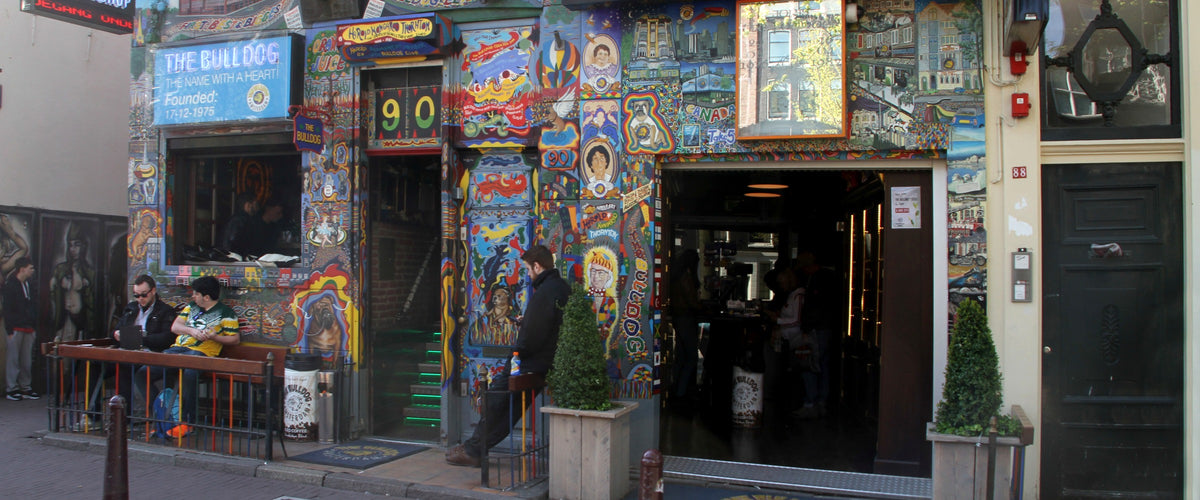
In most cities, a coffeeshop is where you go for an espresso. In Amsterdam, the missing space makes all the difference. A Dutch coffeeshop is an establishment where the sale of small quantities of cannabis is tolerated under strict conditions. It may serve coffee, but coffee is not the reason the word became internationally famous.
The coffeeshop is often presented as proof that the Netherlands legalised cannabis decades ago. That familiar story is simple, memorable and wrong. Cannabis remains prohibited under Dutch law. What developed instead was a carefully bounded decision not to prosecute certain offences when specific rules are followed: the gedoogbeleid, or policy of tolerance.
That compromise grew out of Amsterdam’s counterculture, a national public-health strategy and the practical need to separate cannabis users from dealers in more dangerous drugs. It then became something nobody had entirely planned: an industry, a tourist attraction and one of the most recognisable symbols of the city.
Before the coffeeshop: Amsterdam as a “Magic Centre”
The story begins before there were menus, licences or green-and-yellow signs. During the late 1960s, Amsterdam acquired an international reputation as a place where convention could be challenged. The Provo movement used playful provocation to attack authority and consumer culture. Artists, musicians, squatters and young travellers filled the Dam, the Vondelpark and the city’s new youth venues.
Cannabis was part of this world, but it was still bought largely through informal networks and street dealers. In 1969, cannabis pioneer Kees Hoekert and anti-smoking “magician” Robert Jasper Grootveld openly sold cannabis plants from the houseboat De Witte Raaf under the name Lowlands Weed Company. The boat lay almost opposite a police station: a very Amsterdam mixture of activism, theatre and testing the limits of enforcement.

Amsterdam’s permissive image did not mean that police had stopped enforcing the law. City records show arrests and confiscations in the Vondelpark in the early 1970s. Yet enforcement was selective and increasingly shaped by a larger concern. Heroin use was rising sharply, and policymakers feared that forcing cannabis users into the same illegal market would expose them to harder drugs and more dangerous criminal networks.
That concern produced the central idea behind Dutch cannabis policy: do not pretend every drug carries the same risk, and do not treat every user in the same way.
A shop before the policy
The commercial form appeared before the national rules that would eventually protect it. In 1972, Wernard Bruining and friends opened Mellow Yellow in a squatted former bakery on the Weesperzijde. It called itself a tea house. Customers could order a drink and buy hashish in fixed-price bags, avoiding the bargaining and uncertainty of street dealing.
The Hash Marihuana & Hemp Museum describes Mellow Yellow as Amsterdam’s first coffeeshop. Other names also belong to the pioneering generation—Rusland opened soon afterwards, and Henk de Vries founded The Bulldog in 1975. “First” can become a branding contest, but Mellow Yellow’s 1972 opening is the strongest documented starting point for the recognisable coffeeshop model.
These early businesses were not born legal. They survived in a grey zone, sometimes facing raids or closures, while public policy was changing around them. Their significance was practical: they moved cannabis sales from the street into identifiable premises, where the seller, setting and product were more visible.
1976: separating two markets
In 1976, the Dutch parliament revised the Opium Act. Drugs were divided into two lists: substances considered to carry an “unacceptable risk”, commonly called hard drugs, and cannabis products on a separate list of less serious risk. The distinction did not make cannabis harmless or legal. It made enforcement priorities more proportionate.
The objective was often described as separating markets. Someone seeking hashish or marijuana should not need to buy from a dealer who also offered heroin or cocaine. Keeping cannabis users away from the hard-drug market was treated as a matter of public health and social welfare, not simply permissiveness.
At first, tolerated sales were associated with “house dealers” in youth centres. National prosecution guidelines developed criteria for these dealers, and by 1979 the basic conditions had become formal policy. Courts and local authorities later applied the same logic to the café-like retail outlets that were spreading through Dutch cities. During the 1980s, coffeeshops took over an increasing share of the cannabis market.

This was classic Dutch pragmatism, but not a neat master plan. The government had not designed the colourful storefront, the printed menu or the tourist ritual that would follow. Policy created room; entrepreneurs and customers created the institution.
Tolerated is not legal
The single most important fact about Dutch coffeeshops is also the easiest to miss: selling cannabis remains a criminal offence. Under the tolerance policy, prosecutors refrain from acting against a coffeeshop only when it follows the prescribed criteria.
The best-known rules are summarised by the Dutch initials AHOJ-G:
- A — no advertising (affichering): cannabis may not be actively promoted.
- H — no hard drugs: a coffeeshop must keep the soft- and hard-drug markets separate.
- O — no nuisance (overlast): noise, traffic, litter and disorder can put a permit at risk.
- J — no minors (jongeren): nobody under 18 may enter or buy.
- G — no large quantities (grote hoeveelheden): no more than five grams may be sold in one transaction.
Alcohol cannot be sold or consumed in a coffeeshop. Municipalities decide whether to allow coffeeshops at all, how many may operate and what additional local conditions apply. That is why the experience varies between Dutch cities—and why a national rule should never be confused with a universal invitation.
The national “resident criterion”, introduced in 2013, says that only residents of the Netherlands may enter and buy. The Dutch government itself notes that active enforcement differs by municipality. Amsterdam has not generally used the criterion to exclude foreign visitors, but local policy can change. Anyone planning a visit should check current municipal information rather than relying on an old travel blog or a friend’s heroic recollection of 2008.
Personal possession is not fully legal either. Possession of no more than five grams is normally not prosecuted, but the substance can still be confiscated. Growing cannabis is illegal; with no more than five plants for personal use, police will generally seize the plants rather than prosecute. Tolerance is an enforcement choice, not a right to produce, sell or possess cannabis without limits.
The front door and the back door
The coffeeshop system contains a contradiction that has survived for decades. At the “front door”, a shop may sell small quantities to consumers under controlled conditions. At the “back door”, the commercial cultivation and supply needed to stock that shop remain illegal.
This is more than a legal curiosity. It means a regulated retailer has historically depended on an unregulated supply chain. Shops must know what they sell, yet conventional production has taken place outside the tolerated system. The contradiction complicates quality control and creates opportunities for organised crime, money laundering and violence.
It also explains why calling the Dutch system “legalisation” is misleading. Legalisation would create lawful rules for the full chain—from cultivation and testing to transport and retail. The traditional model regulates only the final step while leaving much of what comes before it in the shadows.
From counterculture to city brand
By the 1980s and 1990s, the coffeeshop had become a recognisable urban type. Some were modest neighbourhood businesses; others developed themed interiors, merchandise and instantly recognisable façades. Names such as The Bulldog travelled far beyond Amsterdam. Guidebooks placed coffeeshops alongside canals, museums and the Red Light District on the standard visitor itinerary.

That fame changed the meaning of the institution. A policy intended to manage a domestic drug market became a reason to travel. For many visitors, stepping into a coffeeshop felt like participation in Amsterdam’s mythology: liberal, informal and unshockable. The shops were no longer just places of sale; they were stages on which the city’s reputation was performed.
The visual language became part of that appeal. Because direct drug advertising is prohibited, recognition often works indirectly: a green cannabis leaf, Rastafarian colours, a punning name, a discreet “coffeeshop” sign or simply the queue outside. The result is a curious streetscape in which an internationally famous product is both obvious and officially not advertised.
Tourism brought revenue and made the policy visible worldwide. It also concentrated nuisance in parts of the old centre. Crowds, street dealing, smoke and the behaviour of a minority of visitors created real tension with residents. Amsterdam’s debate therefore shifted. The question was no longer only whether coffeeshops separated drug markets; it was also what role they should play in a liveable city.
Fewer shops, tighter control
The number of coffeeshops has fallen substantially since its peak. National and municipal authorities tightened licensing, closed non-compliant businesses and used local planning rules to restrict locations. Amsterdam’s Project 1012, aimed at reducing criminal influence and diversifying the historic centre, included the closure of dozens of coffeeshops as well as window brothels and other businesses considered vulnerable.
This did not abolish the model. It made the remaining permits more valuable and the businesses more professionalised. Modern coffeeshops may use security staff, identification checks, sealed product displays and detailed house rules. Some look more like controlled retail counters than the improvised tea houses of the 1970s.

The policy has also become entangled with a broader discussion about overtourism. Research for the City of Amsterdam has shown that coffeeshops are a significant attraction for some young foreign visitors to the central district. That makes them politically symbolic: proposals affecting tourist access promise to reduce one kind of visitor, but may also push sales back toward the street and weaken the separation of markets on which the system was founded.
There is no frictionless answer. A coffeeshop can simultaneously be a controlled alternative to street dealing, a legitimate local business, a magnet for visitors and a source of neighbourhood nuisance. Amsterdam’s policy has to hold all four truths at once.
The controlled-supply experiment
The Netherlands is now testing whether the back-door problem can be addressed. In the Controlled Cannabis Supply Chain Experiment, designated growers produce regulated cannabis for participating coffeeshops. Products are tracked, packaging and quality are supervised, and researchers examine effects on crime, safety and public health.
After preliminary phases in Breda and Tilburg, the experimental phase began on 7 April 2025. Coffeeshops in the ten participating municipalities must sell regulated products supplied by designated growers. The experiment is planned to run for four years, with a possible extension of up to eighteen months.
Amsterdam is not one of those ten municipalities. Plans to add Amsterdam Oost did not obtain the required parliamentary support. So the experiment may influence the future of Dutch policy, but it should not be described as Amsterdam having legalised its coffeeshop supply chain.
The distinction matters. The Netherlands has spent half a century managing cannabis through exceptions and enforcement priorities. The experiment asks whether a transparent, regulated chain can perform better than a tolerated front door attached to an illegal back door.
An Amsterdam institution built on ambiguity
The coffeeshop is neither a libertarian free-for-all nor an ordinary café. It is an institution built from legal ambiguity and practical restraint. Its history runs from hippies on the Dam and house dealers in youth centres to municipal permits, tourism policy and laboratory-tested products in a national experiment.
That ambiguity is why the model has endured—and why it remains contested. Tolerance allowed officials to distinguish between risks without waiting for complete legal reform. It also created contradictions that became harder to defend as the market professionalised and criminal supply networks grew.
For visitors, the best way to understand an Amsterdam coffeeshop is not as evidence that “anything goes”, but as a compact lesson in Dutch governance. The sign may be bright, the rulebook is not. Behind a globally famous attraction sits a very local habit: when law, health, commerce and public order refuse to fit together neatly, build a workable compromise and keep arguing about it.