
The Amsterdam Guide
No house, no coronation: the rise of Amsterdam’s squatters’ movement
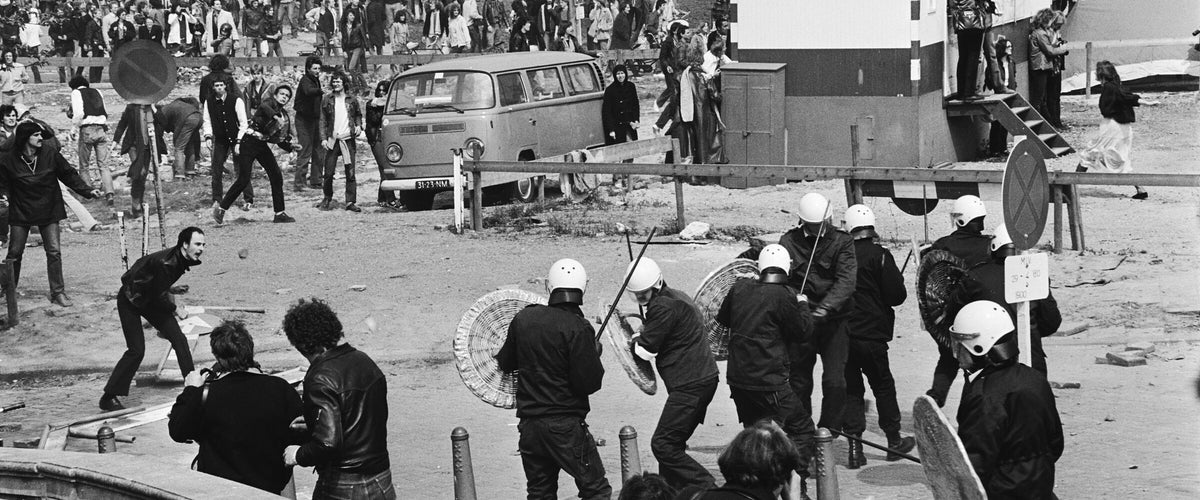
Amsterdam’s squatters did more than force open the doors of empty buildings. They challenged the way the city was being rebuilt, questioned who had the right to live in its centre and turned housing into one of the defining political issues of the 1970s and 1980s.
The movement is often remembered through its most dramatic images: barricades, riot police, smoke and the slogan Geen woning, geen kroning — “No house, no coronation.” But the story began long before the riots of 1980. It grew from a simple and increasingly urgent contradiction: thousands of people needed somewhere to live, while homes and other buildings stood empty.
A city with houses, but not enough homes
Amsterdam’s post-war housing shortage continued well into the 1960s. Young adults could spend years on waiting lists, affordable rooms were scarce and many older neighbourhoods had been neglected. At the same time, buildings in and around the historic centre were left vacant, sometimes because owners were waiting to redevelop them and sometimes because entire streets were marked for demolition.
For a new generation of Amsterdammers, that empty space became impossible to ignore.
One of the first widely reported occupations took place in January 1965, when a newly married couple moved into an empty home in the Generaal Vetterstraat without permission. They were not yet called krakers. The Dutch term developed later, borrowing the idea of “cracking” a building open.
By the end of the decade, squatting had become more organised. Activists published instructions, identified vacant properties and helped people enter and repair them. For some, it was primarily a way to find a home. For others, it was a direct protest against speculation, demolition and a housing system they believed had failed.

1970: squatting becomes a movement
On 5 May 1970, activists organised a national day of squatting. The action connected individual occupations to a broader political movement and made the housing shortage visible on the streets.
Amsterdam’s squatters built an unusually practical network. Local groups kept lists of empty buildings, researched ownership, shared legal advice and knew which tools were needed to make a neglected property habitable. A successful occupation could mean replacing locks, reconnecting water and electricity, repairing roofs and clearing years of rubbish.
The movement was never one uniform organisation. It included students, young families, artists, anarchists, neighbourhood activists and people who simply needed somewhere affordable to live. Some houses became quiet shared homes. Others developed into printing workshops, cafés, music venues, childcare spaces or political centres.
That mixture was one of the movement’s strengths — and later one of its fault lines.

Fighting for the old city
Housing was not the only issue. During the 1960s and 1970s, Amsterdam planned large-scale modernisation projects that would replace parts of the old city with offices, roads and infrastructure. In the Nieuwmarkt neighbourhood, houses were demolished to make way for the new metro line and a proposed urban motorway.
Residents and activists occupied threatened buildings and resisted eviction. The Nieuwmarkt protests of 1975 ended in violent confrontations with the police, but the wider campaign changed Amsterdam’s direction. The metro was completed; much of the planned road construction was not. The city increasingly moved away from wholesale demolition and towards renovation that kept existing communities and street patterns in place.
Squatters were not solely responsible for that change, but they were part of a much broader neighbourhood movement that forced the city to reconsider what progress should look like.
The legal grey area
For decades, squatting in the Netherlands occupied an unusual legal position. Breaking into a property could be an offence, but living in a building was protected by the principle of domestic peace. Once squatters had established a home — traditionally demonstrated with a table, a chair and a bed — an owner could not simply send people in to remove them. Eviction generally required legal proceedings.
This did not make squatting “legal” in the simple sense. It created a grey area in which the rights of an owner, the status of an empty property and the home rights of its new occupants had to be weighed against one another. That ambiguity allowed the movement to grow, while ensuring that almost every major eviction could become a legal and political battle.
From the Vondelstraat to the coronation riots
By early 1980, the relationship between the movement and the authorities had reached breaking point. In March, an eviction in the Vondelstraat led to barricades and fierce street fighting. Police used tear gas, and armoured vehicles from the Dutch army were brought in to clear the street.
Only weeks later, Queen Juliana was due to abdicate and Beatrix was to be inaugurated in Amsterdam. The ceremony required an enormous security operation at a time when the city’s housing crisis remained painfully visible. The slogan Geen woning, geen kroning captured the anger perfectly: why spend so much on a royal celebration while people still could not find homes?


On 30 April 1980, the official ceremony took place in the Nieuwe Kerk while the centre of Amsterdam erupted outside. Demonstrators and riot police fought for hours around the Dam, Rokin and Blauwbrug. Stones and smoke bombs were thrown; mounted police and water cannon were deployed. Hundreds of people were injured.
The coronation riots became the most famous episode in the history of the Dutch squatters’ movement. They also changed its public image. The movement’s argument about empty buildings and unaffordable housing was increasingly overshadowed by images of street violence.

More than barricades
The movement did not disappear after 1980, but it became more divided. Some groups favoured direct confrontation, while others focused on legalisation, neighbourhood work and creating long-term places to live and work. Public support weakened when actions became violent, yet many occupied buildings quietly developed into durable communities and cultural spaces.
Squatting also preserved parts of Amsterdam that might otherwise have been demolished or left to decay. Former warehouses, schools, offices and industrial sites were repaired and reused. Several were eventually bought or legalised. The city’s later broedplaatsen policy — supporting affordable creative workspaces — owes something to the live-work buildings and cultural centres first created from below.
The legacy can be seen in places such as NDSM, OT301 and other former industrial or institutional buildings that became centres for art, music and alternative culture. Their histories are different, and not every one began in the same period, but they share an idea the squatters helped establish: an empty building can be more valuable when people are allowed to use it.
The end of an era?
Over time, the rules became stricter. From 1994, a building generally had to have stood empty for at least a year before it could fall within the old squatting framework. On 1 October 2010, squatting became a criminal offence throughout the Netherlands.
That law ended the movement’s exceptional legal position, but it did not end the argument behind it. Amsterdam once again faces severe pressure on affordable housing, and vacant buildings still provoke debate. The language has changed, the laws have changed and the barricades have largely disappeared — yet the central question remains strikingly familiar: who is the city for?
The squatters’ movement never offered one neat answer. It contained idealism and intimidation, careful restoration and destructive confrontation, open communities and closed political groups. Its history is uncomfortable precisely because it cannot be reduced to heroes and villains.
What it undeniably did was force Amsterdam to look through the windows of its empty buildings and see wasted homes, threatened neighbourhoods and possibilities the official city had overlooked.