
The Amsterdam Guide
Look up: the stories hidden in Amsterdam’s façade stones
Amsterdam rewards people who look up. Above shopfronts, beside doorways and between rows of windows, small carved stones are set into the city’s brick façades. Some show ships or animals. Others depict tools, saints, flowers, distant places or scenes from everyday work.
These are gevelstenen — façade stones or gable stones — and they once helped Amsterdam find its way around.
Long before a street address could be typed into a phone, a picture carved in stone could tell visitors where they had arrived, who lived there or what happened inside. Today, hundreds survive across the city, quietly preserving fragments of Amsterdam’s commercial, religious and domestic history.
Before houses had numbers
Façade stones became popular from the sixteenth century onwards, when Amsterdam did not yet have the familiar system of numbered street addresses. A house could instead be known by a name and an image: a lion, a ship, a crown, a mill or almost anything memorable enough to distinguish it from its neighbours.
That visual language had an obvious advantage in a city where not everyone could read. A painted relief could be recognised from the street, while a written description might mean little to part of the population.
Directions were consequently more imaginative than the ones we use today. Rather than looking for number 63, a visitor might be told to find the house called De Blom Kool — The Cauliflower — or to stop beside a stone showing a particular trade.

A shop sign carved in stone
Many stones acted as permanent advertisements. Bakers, brewers, merchants, craftsmen and innkeepers could place a recognisable symbol above their premises. A barrel might point to drink, a tool to a particular craft and a ship to maritime trade.
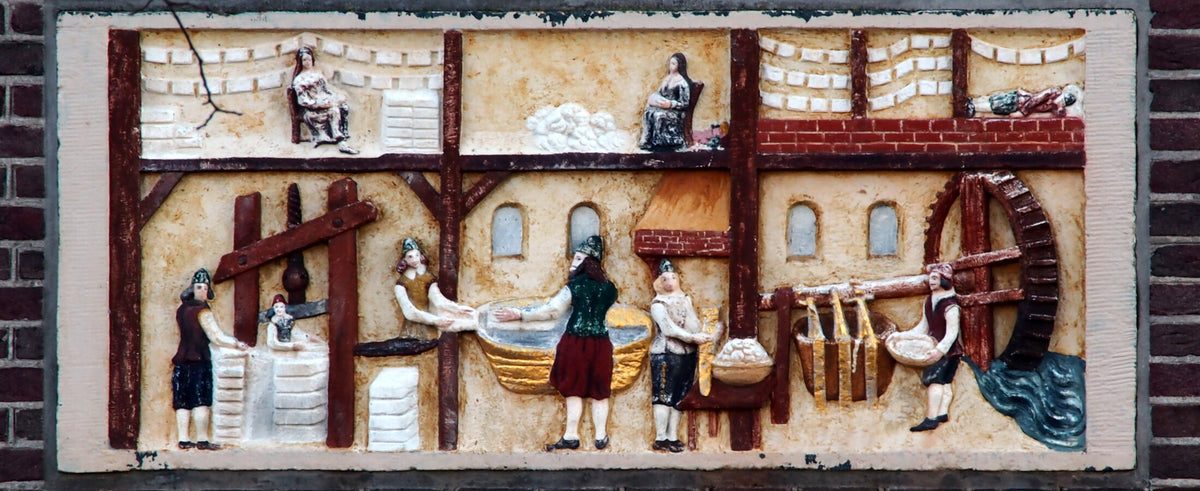
Some scenes are wonderfully detailed. The façade stone at Herengracht 107 shows the interior of a paper mill, turning a business activity into a miniature carved tableau. It did more than identify an address: it presented the work carried out there and gave the building a public identity.
In a trading city, that mattered. Amsterdam’s wealth depended on goods, skills and networks, and the façades became a kind of visual directory of urban life.

Names, origins and private jokes
Not every image was a straightforward business sign. A stone might refer to the owner’s surname, birthplace, family emblem or religious beliefs. Some were visual puns whose meaning was clear to contemporaries but has become harder to decipher with time.
Others marked a house with an invented name, much as people still name country houses, boats or holiday homes today. The building gained a personality of its own — one that could remain long after its original owner had disappeared.
Dates and inscriptions added further clues, but they do not always tell the whole story. A year may commemorate construction, rebuilding or a new stone rather than the first appearance of the house itself. Reading a façade stone is therefore part history and part detective work.

More than decoration
The stones were practical, but their makers did not treat them as mere labels. Carved borders, expressive figures and painted details turned them into small works of public art. Against Amsterdam’s dark brick, their lighter stone and bright colours could make even a modest house distinctive.
They also offer an unusually personal view of the past. Grand civic buildings tell us about institutions and power; a façade stone may tell us what one resident sold, where another came from or which image a family wanted the street to associate with their home.
Some subjects need to be viewed critically. Amsterdam’s façades also reflect the city’s colonial trade, religious divisions and unequal distribution of wealth. The stones are not a complete or neutral account of history, but they are valuable evidence of how earlier residents chose to present themselves.
From address system to urban heritage
Once systematic house numbering became established, façade stones were no longer needed for navigation. Many disappeared when buildings were demolished or altered; others were removed and later preserved in museum collections or incorporated into new walls.
Fortunately, the tradition never vanished completely. Historic stones have been researched, cleaned, repainted and restored, while new ones are still commissioned. Modern examples may refer to a present-day resident, a renovation, a profession or a joke — proof that Amsterdam still enjoys giving its houses a little character.

Where to spot them
You can find façade stones throughout Amsterdam’s historic centre, but the Jordaan, Haarlemmerbuurt and streets around the old canal belt are particularly rewarding. The Begijnhof also contains a notable group, and the Amsterdam Museum has preserved stones that no longer remain on their original buildings.
Do not search only at the very top of the gable. Many stones sit above a ground-floor doorway or between the lower windows — close enough to see the carving, but high enough to be missed when your attention is on bicycles, bridges and oncoming traffic.
Take your time and compare the image with the building around it. Is it a profession, a family name, a place, a saint or simply a joke that has survived for centuries?
In Amsterdam, a front wall is rarely just a front wall. Sometimes it is an address book, an advertisement and a family story — all carved into one small piece of stone.